Holidays are over, I came back very late last Monday night, full of heat, and sun, and nice food, smells and images to last me quite a while. Landing in Dublin to a temperature of 13 degrees (Celsius) after anything from 36 to 40 in the afternoon shade on the coast and just under 30 in the mountains was to be expected, but still a shock to the body! I do love heat, and I still think that, though I love living in Ireland, it could be hotter… But then it wouldn’t be Ireland, would it?
This is a quick post on Sardinia, a Mediterranean island that does deserve to be visited. My main impression is that, generally speaking, it is very unspoiled. The North West coast I travelled on and the Northern interior I explored boast some incredible scenery. Hard to do justice to such an intricate place in just one week (I did not have time to venture into what is supposed to be the most stunning mountainous parts according to the Lonely Planet guidebook), and then just a short post! I just want to state a few things here:
- We all have a responsibility to sustain and protect our planet, and the beauties it compasses. I have been privileged to witness a few in the last few years, and though I am all too aware that my carbon footprint goes quite high when I fly off to these places, I am so grateful to be allowed to experience such beauties.
- On my last day there, I made a last minute detour of about 80km to take what turned out to be the second most beautiful and scenic coastal drive I have ever been on, from Bosa to Alghero (my no. 1 favourite is the Great Ocean Road west of Melbourne, Australia).
- The sea so clear and warm. The countryside so burn in this late summer. The mountains so rugged and wild. Little lakes hidden away among the pine forests or the cork-oak forest (and I do mean cork tree, the bark stripped to make… corks!)
- I saw the famous and very unique wild Albino donkeys of the Parco Nazionale dell’Asinara (asinara is the Italian for donkey… dictionaries are great!) as well as eagles and pelegrine falcons in full flight, and met a wild boar who was quietly crossing the road as I was carefully driving down the top of a mountain – my driving skills pushed to the ultimate test on Monti Limbara, with a 10% incline over 9 km, hairpins all the way and no safety barrier for the last third of the climb… and back down! But what a view at the top! Breath-taking.
This is a quick post on Sardinia, a Mediterranean island that does deserve to be visited. My main impression is that, generally speaking, it is very unspoiled. The North West coast I travelled on and the Northern interior I explored boast some incredible scenery. Hard to do justice to such an intricate place in just one week (I did not have time to venture into what is supposed to be the most stunning mountainous parts according to the Lonely Planet guidebook), and then just a short post! I just want to state a few things here:
- We all have a responsibility to sustain and protect our planet, and the beauties it compasses. I have been privileged to witness a few in the last few years, and though I am all too aware that my carbon footprint goes quite high when I fly off to these places, I am so grateful to be allowed to experience such beauties.
- On my last day there, I made a last minute detour of about 80km to take what turned out to be the second most beautiful and scenic coastal drive I have ever been on, from Bosa to Alghero (my no. 1 favourite is the Great Ocean Road west of Melbourne, Australia).
- The sea so clear and warm. The countryside so burn in this late summer. The mountains so rugged and wild. Little lakes hidden away among the pine forests or the cork-oak forest (and I do mean cork tree, the bark stripped to make… corks!)
- I saw the famous and very unique wild Albino donkeys of the Parco Nazionale dell’Asinara (asinara is the Italian for donkey… dictionaries are great!) as well as eagles and pelegrine falcons in full flight, and met a wild boar who was quietly crossing the road as I was carefully driving down the top of a mountain – my driving skills pushed to the ultimate test on Monti Limbara, with a 10% incline over 9 km, hairpins all the way and no safety barrier for the last third of the climb… and back down! But what a view at the top! Breath-taking.
- The food, the food, the incredible food! I tried every thing, though I can say I do not particularly like baby octopus… but I tried. Roasted Suckling Pig is typical of Sardinia and is just delicious. So is Seadas, a dessert made of a light deep-fried pastry wrapped aroung some soft and mild cheese, served hot and totally covered with honey… aaaah….! As for fish and prawns, I gorged on them, and I am not ashamed to say it!
- The history of the island is so rich, and I was lucky enough to find and visit such sights as a 5,000 years old Necropolis (I was very moved by the carvings over the doors, evidence of faith and hope of a deeply religious people), two of the most subtential Nuraghe sites on the island, dating from about 3,500 years ago, one being the Nuraghe village of Palmavera, made up of the remains of a main tower, of an assembly hall, and of some 50 dwellings (near Alghero if you fly there); the other was inland near Tempio, the magnificent tower of Nuraghe Maiori, shouldering on a rock in the middle of a cork forest. Just to put things into perspective, there are still over 7,000 Nuraghe towers scattered around the island. Then they were the little churches and chapels dotting the countryside. I happened on one by chance, driving by slowing enough to see the door was opened: I stopped, went in, was taken aback by the sheer beauty of the simple architecture, only to realise as I was coming out that a date was inscribed in the stone over the door: MII. Yes this is over 1,000 years old! How many people stop and go in? I also spend an all too short evening walking the twisty streets of the old city of Alghero, ending with dinner on the old sea-walls while watching the sun setting over the bay.
As for my non existent Italian, a combination of English, French and the help of my dictionary got me by. Also I was fortunate to meet Paola during my day trip to the natural reserve of Isola Dell’Asinara. Paola is an English teacher and was a god-sent, she spent the day translating for me the guide’s information and gave me such an insight into this wonderful place.
God! How beautiful is our planet! Here is just but a taste if you are ever tempted to go there. And let me know, I would gladly join you there!


Cathal loves this photo. When I explained they were albino donkeys, he looked at me with a very serious face and said his famous "a dddd!" :-)

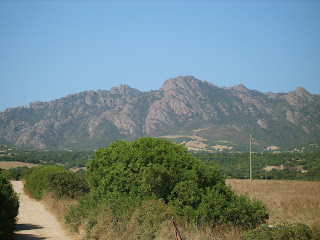
Taken by the side of a mountain road, in the heat of the afternoon. Even when the sun seems to burn everything, delicate beauty emerges...

2 views from the top of Monti Limbara:


A cork oak tree:

The interior of the 1,000 year old chapel called (according to the map) San Pietro di Ruda. It is at least 10km from any village!

A 12th century church, Nostra Signora di Castro, again in the middle of nowhere. I was so taken by the colour of the stones, each one is a different shade. The inside is equally beautiful.

One of the many views on the last coastal drive:

So, what do you think? Isn't it tempting?